
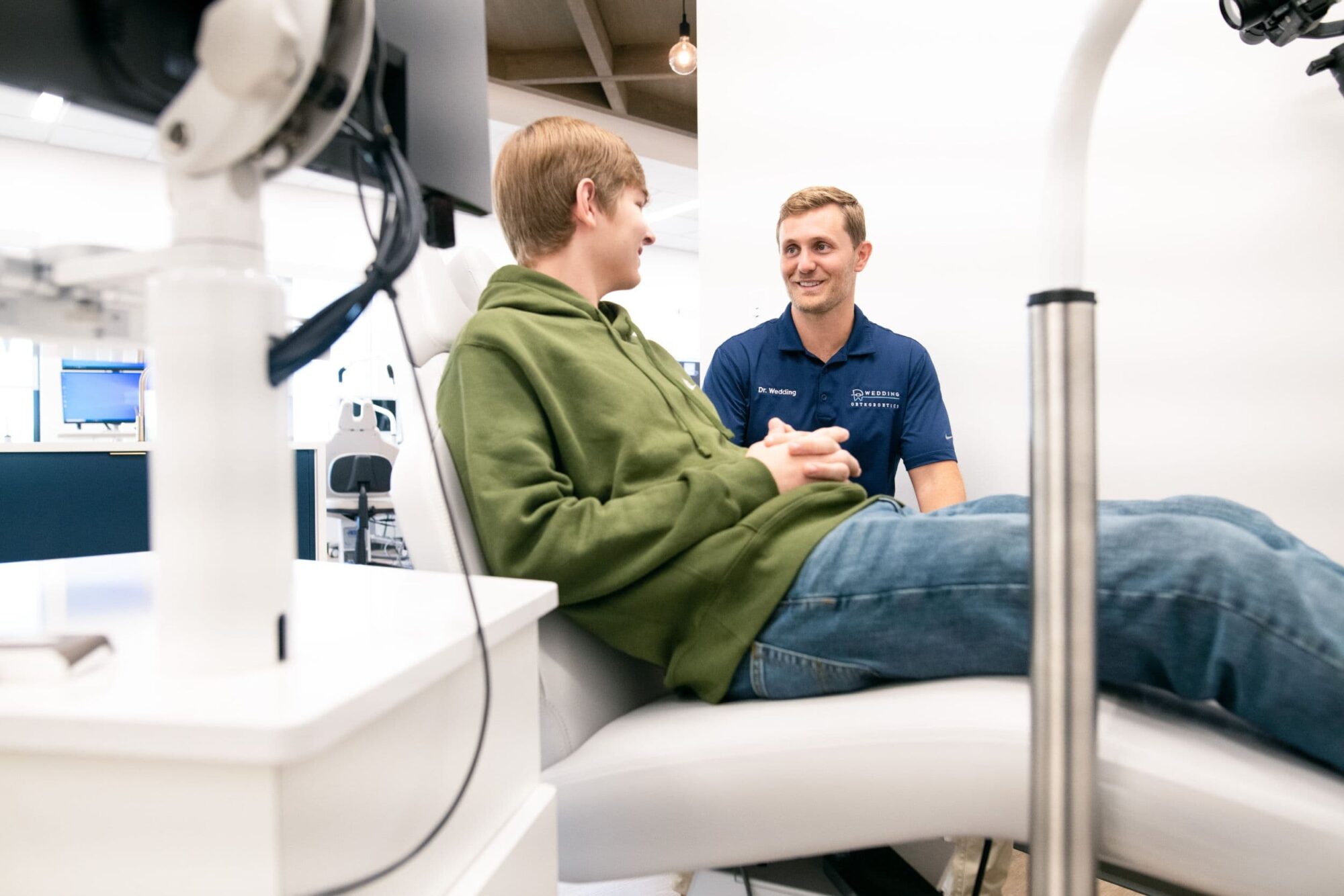
What Are Braces for Teens?
Braces for teens are fixed appliances that gently move teeth into proper alignment while your child is still growing. Most teenagers start treatment between ages 11 and 14, once most permanent teeth have come in. That window is what makes tooth movement efficient and predictable.
The teen years line up two helpful things at once. Jaws are still growing, and permanent teeth erupt in a fairly predictable order. That combination gives Dr. Justin Wedding and Dr. Sam Thompson room to guide teeth and bite alignment at the same time, instead of working against a fully set adult jaw.
Treatment at this age can correct crowding, spacing and gaps, crossbite, overbite, underbite, open bite, and gummy smile concerns.
One more thing worth clearing up: “braces” is really an umbrella term now. Fixed metal braces, clear braces, and Invisalign clear aligners all fall under teen orthodontic treatment, and plenty of teens are great candidates for more than one option.

How Teen Braces Work, Step by Step
Teen braces work by applying steady, light pressure through brackets and an archwire, which remodels the bone around the tooth roots so teeth shift into position. Treatment starts with a free consult and records, moves through a placement check-up, then continues with adjustment visits every four to eight weeks until retainers protect the finished smile.
Dr. Wedding and Dr. Thompson are orthodontic specialists, which means additional years of training beyond dental school devoted entirely to tooth movement, bite correction, and jaw growth. That background is why the plan your teen leaves with is built around their specific case instead of a template. It’s also why the group of people cheering your teen on at every visit becomes your brand new hype team from the very first check-up.
Here’s how the process usually unfolds:
- Free consultation and records. Dr. Wedding or Dr. Thompson examines your teen’s teeth, bite, and jaw growth. We use a digital scanner instead of goopy molds, along with x-rays, and we talk through what your teen actually wants from their smile.
- Custom treatment plan. You’ll see the recommended appliance type, an estimated timeline, and how often your teen needs to come in. Questions are welcome. Bring all of them.
- Placement check-up. Brackets are bonded to each tooth and the archwire is placed. Plan on roughly 60 to 90 minutes, and expect your teen to leave talking a little funny for an hour or two.
- Adjustment visits every 4-8 weeks. We change wires, swap elastics, and check progress. These visits are short, and they’re where the real momentum happens.
- Debonding day. Brackets come off, teeth get polished, and your teen sees the results in the mirror. This is everyone’s favorite check-up.
- Retainers. Teeth have memory. Wearing a retainer as directed is what keeps that new alignment in place for good, and keeping that retainer clean matters more than most families expect.
Most teens finish in 12 to 30 months. Mild crowding wraps up faster. Bite correction, impacted teeth, or cases needing elastics take longer.
Benefits of Orthodontic Treatment During the Teen Years
Orthodontic treatment during the teen years improves oral health, bite function, and confidence at the same time. Straighter teeth are easier to brush and floss, a corrected bite spreads chewing forces evenly across the arch, and guiding teeth while the jaws are still growing often keeps treatment shorter and more straightforward than waiting until adulthood.
Why Are Straighter Teeth Easier to Keep Clean?
Straight teeth are easier to keep clean. That’s not a small perk. Crowded and overlapping teeth trap plaque in spots a toothbrush can’t reach, which raises the risk of decay and gum disease over a lifetime.
Aligned teeth also give floss a clear path between each contact point, so your teen’s two-minute routine actually reaches every surface. Fewer hiding places for plaque tends to mean fewer fillings, calmer gum tissue, and quicker cleanings at the dentist for years after the brackets come off.
How Does Bite Correction Help Long-Term?
The bite matters just as much as the look:
- Even wear. A corrected bite spreads chewing forces properly, so enamel doesn’t wear down in one concentrated area.
- Less jaw strain. Teeth that meet correctly put less stress on the jaw joints and muscles.
- Better function. Many teens chew more comfortably after treatment, and some see clearer speech once crowding or an open bite is resolved.
- Breathing considerations. Certain bite and airway concerns can improve when the jaws are guided during growth.
- Confidence. High school photos, first jobs, first dates. A smile your teen actually likes showing off carries real weight during these years.
Why Is the Teen Window Such Good Timing?
Timing helps, too. Because the jaws are still developing, Dr. Wedding and Dr. Thompson can often guide growth now and reduce the need for more involved treatment later in adulthood. Waiting doesn’t make a case simpler.
Treatment also fits the school calendar reasonably well. Adjustment visits are short, spaced weeks apart, and we work around practices, band, and exam weeks whenever we can.
Teen Braces Options Compared: Metal, Clear, and Invisalign
Three main options, three different personalities. Here’s how they stack up. If you want a closer look at just the two fixed options, our breakdown of metal braces versus clear braces goes deeper on that comparison.
| Metal Braces | Clear Braces | Invisalign Clear Aligners | |
|---|---|---|---|
| Visibility | Most noticeable, though brackets are smaller than they used to be | Tooth-colored brackets blend in for a lower-profile look | Nearly invisible when worn |
| Case complexity | Handles the widest range, including complex bite correction | Handles most cases with slightly more care | Handles many mild to moderate and some complex cases |
| Removable? | No, working 24/7 | No, working 24/7 | Yes, removed for eating and brushing |
| Daily care | Brush around brackets, floss with a threader or water flosser | Same routine, plus limiting staining foods and drinks | Rinse aligners, brush before reinserting, keep the case handy |
| Sports and instruments | Orthodontic mouthguard recommended | Orthodontic mouthguard recommended | Remove for contact sports and wind instruments |
| Responsibility required | Low, they’re always on the job | Low | High, 20 to 22 hours of wear daily |
| Color options | Yes, new elastic colors at every check-up | Subtle, natural look | No brackets to color |
Metal braces are the workhorse. They’re strong, versatile, and they don’t care whether your teen remembers anything, because they never come off. For heavy crowding or significant bite correction, they’re often the most direct route.
Clear braces straighten teeth the same way with white ceramic brackets that blend with the natural tooth. Teens who want treatment to fade into the background usually love them. The brackets themselves won’t stain, though the adhesive and clear elastic ties can pick up color from things like coffee, tea, and tomato sauce.
Invisalign clear aligners come out for meals, brushing, and big events. Hygiene is simpler, and there’s nothing to break during a game. The trade-off is discipline: aligners only work while they’re in the mouth. Our page on clear aligners for teens covers how that works in practice.
Our honest guidance to parents? Match the option to two things, your teen’s case and your teen’s habits. If your teen loses a water bottle every other week, fixed braces remove the guesswork. If they keep track of their retainer, phone, and homework without reminders, aligners are absolutely worth discussing. Dr. Wedding and Dr. Thompson will tell you straight which options will actually deliver the result you’re after.
Is Your Teen a Good Candidate for Braces?
Most teens with alignment or bite concerns are candidates. The clearer question is timing, and that’s what an exam sorts out. Because Dr. Wedding and Dr. Thompson are orthodontic specialists, a single visit with a digital scan usually tells you whether to start now, start in six months, or simply keep an eye on how things develop.
Signs worth a look:
- Crowded, overlapping, or twisted teeth
- Noticeable gaps between teeth
- Front teeth that protrude or stick out past the lower teeth
- An overbite, underbite, crossbite, or open bite
- Teeth that don’t meet properly when your teen bites down
- Baby teeth lost unusually late, or permanent teeth erupting out of position
Symptoms and habits also tell a story. Mouth breathing, jaw clicking, trouble chewing, frequent cheek or tongue biting, and teeth grinding all deserve attention.
For full treatment, most permanent teeth should be in place. That’s why the 11 to 14 range comes up so often. Some teens benefit from a shorter early phase first, then a second phase once remaining teeth arrive.
The American Association of Orthodontists recommends that every child see an orthodontist by age 7, even when treatment won’t start for years. That’s the thinking behind our SUPER 7 program. An early look lets Dr. Wedding and Dr. Thompson track growth and start at the ideal moment instead of playing catch-up.
Never had that early evaluation? No problem at all. Plenty of our teen patients come to us for the first time at 13 or 14.
Frequently Asked Questions About Braces for Teens
How long do teens wear braces?
Most teens wear braces for 12 to 30 months. Mild crowding or spacing can be resolved on the shorter end, while cases involving significant bite correction, impacted teeth, or elastics usually run longer. Dr. Wedding or Dr. Thompson gives you an estimated timeline at the free consult, and consistent wear of elastics keeps treatment on schedule.
Do braces hurt?
Braces don’t hurt to place. Bonding brackets involves no needles and no drilling. Teens typically notice mild soreness and tenderness for two to four days after placement and for a day or so after adjustments, which softer foods and over-the-counter relief handle well. That tenderness fades as teeth settle into their new positions.
Can teens play sports with braces?
Absolutely. Football, basketball, soccer, wrestling, all of it. Your teen just needs an orthodontic mouthguard designed to fit over brackets, which we can help you select. Teens in clear aligners simply remove the aligners and wear a standard mouthguard, then pop the aligners back in afterward.
Are clear aligners a good fit for teenagers?
Clear aligners work beautifully for teens who wear them 20 to 22 hours a day, every day. Aligners only move teeth while they’re in the mouth, so treatment stalls if they spend the afternoon in a backpack. We talk honestly with families about responsibility before recommending aligners, because the right option is the one your teen will actually use.
What foods should my teen avoid with braces?
Hard, sticky, and chewy foods are the main culprits, since they can loosen brackets or bend wires. Skip caramel, taffy, gum, hard candy, ice, popcorn kernels, and nuts. Crunchy favorites like apples, carrots, and corn on the cob are still fine when cut into smaller pieces. Teens in clear aligners remove them to eat, so food restrictions mostly disappear.
Will my teen need a retainer afterward?
Yes, and this part matters. Teeth naturally drift back toward their old positions without retention, so a retainer is what protects the result. We’ll explain exactly how long to wear it each day and check the fit at follow-up visits. Most teens shift to nighttime-only wear over time.
Can teens get braces if they still have a few baby teeth?
Sometimes. It depends on which teeth remain and where the permanent teeth are heading. In some cases we start a short first phase to create room or guide growth, then complete treatment once the remaining permanent teeth arrive. An exam and digital scan answer this quickly.
Wondering where your teen stands? Schedule a free consult with Dr. Wedding or Dr. Thompson and you’ll leave with a real answer, a plan, and a timeline. Say hello to your new smile whenever your family is ready.